School Branding Blog
The Hidden Cost of an Outdated School Brand: What Enrollment Decline Really Signals
- Author
- Mash Bonigala · Creative Director
- Published
- March 24, 2026

I get the same call about once a week. A principal or superintendent, sometimes a board member, describing a school where the academics are solid, the teachers care, the test scores compete. Enrollment is sliding anyway. Open houses pull fewer families each fall. The charter school 2 miles down the road keeps growing.
They’ve tried bumping the ad spend. They’ve posted more on Facebook. They printed new brochures. None of it moved the needle, and they can’t figure out why.
When I look at these schools (and I have looked at well over 250 of them at this point), the answer is almost always the same. The school is good. The brand is bad. Families are making decisions based on what they see, and what they see looks like 2009.
Related: school branding strategy | visual identity design | brand audit checklist
Data: Public school enrollment is down 2.5% since 2019, charter enrollment is up 15% in six years, and 75% of parents considered or searched for a new school last year. Sources for all of it are on our School Branding & Enrollment Statistics 2026 page.
What Happens When a Brand Goes Stale
This plays out in stages, and it compounds. A school that lets its brand sit untouched for 5, 10, 15 years doesn’t just fall behind gradually. It falls behind and then the falling accelerates.
The first year is quiet
Families researching schools online compare your website to the charter school’s website. Yours has a rotating slideshow from 2017 and a logo that pixelates on a phone screen. Theirs looks like it was designed this year (because it was). They click away. You never know they existed.
Website engagement drifts down. Social media flatlines. Open house numbers soften. Everyone blames scheduling conflicts or the weather.
Most schools at this stage do the worst possible thing: they spend more money advertising the same broken brand. It’s like turning up the volume on a bad song.
The second year gets uncomfortable
Applications start to slide. Hiring gets harder because prospective teachers Google the school and find a website that doesn’t inspire confidence (we wrote about how branding affects teacher recruitment separately, and the data there is striking). Current parents can’t explain what makes the school special because the messaging doesn’t give them anything specific to say.
The families you’re losing aren’t the ones who visited and chose elsewhere. They’re the ones who never visited at all. When your positioning is muddy, you become invisible to the families you most want to reach.
Year three is a budget meeting nobody wants to have
Revenue shortfalls force program cuts. Program cuts make enrollment worse. Staff turnover ticks up because morale tracks reputation, and reputation tracks brand. Board confidence drops. Getting approval for the investment you actually need becomes harder precisely when you need it most.
I’ve watched this play out at charter schools, public schools, small private schools, and rural districts. The speed varies. The trajectory does not.
7 Warning Signs That Your Brand Is Costing You Families
These are the patterns I check for when a school calls us. If 3 or more of these are true at your school, the brand is likely a drag on enrollment whether anyone has named it as the problem or not.
1. The screenshot test
Open your website next to your 3 closest competitors. Just look at them side by side. If yours looks dated, cluttered, or inconsistent compared to theirs, families are noticing. Parents spend only moments on a school website before they decide to dig deeper or bounce. A brand audit will tell you exactly where the gaps are, and comparing against current design standards will show you how wide those gaps have gotten.
2. The messaging sounds like everyone else
Count how many times the word “nurturing” appears on your website. Count “well-rounded.” Count “preparing tomorrow’s leaders.” These phrases are in every school brochure I have ever read, and they communicate nothing. When every school says the same thing, no school stands out. A clear brand voice fixes this, and the difference in conversion rates between generic messaging and specific messaging is large.
3. The logo has aged out
If your logo was designed more than 10 to 15 years ago, it almost certainly has problems you can’t see until you test it: it breaks at small sizes, it muddles on dark backgrounds, it looks amateur next to what competing schools are putting on their jerseys. Our post on when to redesign your school logo covers the specific signals.
4. Your colors are working against you
I’ve walked into schools where the building is painted one shade of blue, the website uses another, the jerseys use a third, and the sign out front is faded to a fourth. Color psychology matters in brand perception, but it only works when the colors are actually consistent and intentionally chosen.
5. Nothing matches
The website shows one logo. The gym banner shows another. The letterhead is a third version somebody made in Word 8 years ago. Every mismatch tells a family that nobody is paying attention. Consistency across touchpoints is one of the strongest predictors of enrollment conversion we track. Brand guidelines fix this, and they’re worth more than most schools realize (we wrote a whole piece on why).
6. Competitors rebranded and you didn’t
When 2 or 3 neighboring schools invest in professional branding and yours stays the same, the contrast tells a story. It tells families which schools are growing and which ones are standing still. In competitive markets where charter schools are actively recruiting, that contrast accelerates quickly.
7. The mascot embarrasses more than it inspires
Your mascot should be the thing students put on their backpacks and parents wear to pickup. It should be the identity that ties the community together. When the mascot looks like clip art from 1998, kids won’t wear it, parents won’t display it, and the whole spirit wear program stalls. Schools that invest in professional mascot design see dramatic increases in merchandise adoption and student pride. Woodbridge School District is a good example of what that transformation looks like.
What This Actually Costs in Dollars
School leaders tend to think of branding as a cost. I want to flip that and show you what not branding costs.
Take a school with 500 students at per-pupil funding around 10,000. If you’re losing 5 percent of enrollment per year because of brand perception (and that’s a conservative number for schools with stale identities), that’s 25 students, which is a quarter million dollars in annual revenue. Over 3 years, that’s 750,000 or more. At 10 percent attrition, you’re looking at half a million annually.
A comprehensive rebrand runs somewhere in the range of 15,000 to 75,000 depending on scope. The math is not close.
Beyond the direct enrollment losses, an outdated brand makes everything else more expensive too. Recruiting teachers costs more because you’re not attracting talent organically. Your advertising spends harder for fewer conversions because you’re promoting a brand that doesn’t land. Bond referendums get harder to pass because community confidence tracks perception. Grant applications with dated branding look less professional, and reviewers notice.
Schools that invest in strategic rebranding and execute a real launch plan consistently see enrollment inquiry increases within 12 months, meaningful website engagement improvements, and parent referral rates that climb through the first academic year. We break down the measurement side in our ROI guide, and the timeline for when results actually appear is covered in our honest rebrand timeline post.
How to Fix It
If you see your school in the warning signs above, the path forward depends on how deep the problem goes. Not every school needs a full rebrand, and choosing wrong between a refresh and a rebrand wastes money either way.
Start by diagnosing. Use our 15-point brand audit checklist and be honest about what you find. Audit the visual identity, check what competitors are doing, survey families (both current and prospective), and score your digital presence.
Then build the strategy before you touch a single design element. Most schools skip straight to “we need a new logo” without defining their positioning, their messaging, or their voice. That’s how you end up with a pretty logo that still doesn’t convert.
Execute the design with the full system in mind. A logo, colors, typography, visual identity system, and mascot if you have one. Everything needs to be built as a family of connected pieces, not isolated projects.
Roll it out with intention. Campus signage, digital presence, email campaigns, open house materials, spirit wear. The first 100 days after launch determine whether the investment compounds or fizzles.
Measure what matters. Enrollment inquiries, website engagement, conversion rates, referral volume, staff recruitment metrics. Track them before launch, at 90 days, at 6 months, at a year.
Getting It Past the Board
This is the part where most projects stall. You know the brand needs work. Getting the board to fund it is a different conversation.
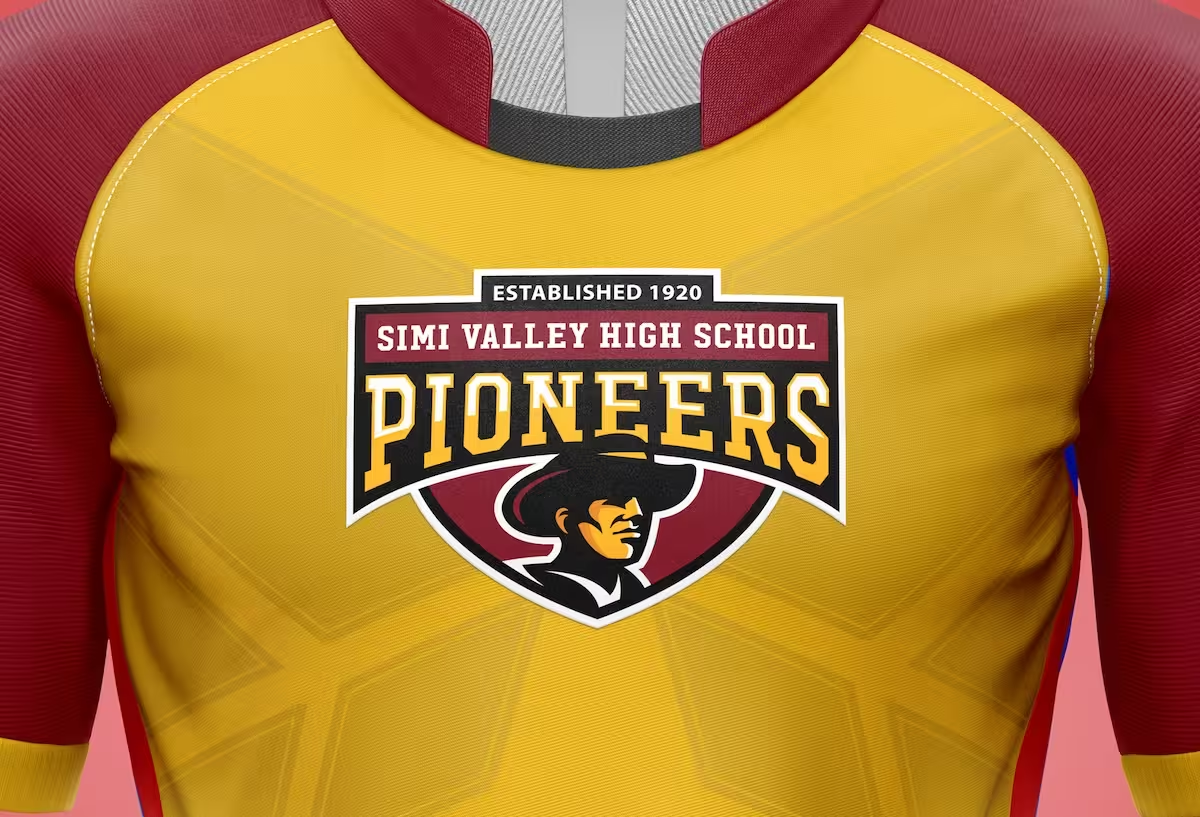
Lead with the enrollment revenue data, not the design. Board members respond to the gap between what enrollment decline costs and what a rebrand costs. Show them what competing schools have done. Visual before-and-afters do more than any spreadsheet. Reference schools like Henderson Collegiate and Simi Valley High School that invested and saw measurable returns. Our board approval guide walks through the full process.
The gap between your school’s actual quality and how the community perceives that quality is the most expensive problem you’re not tracking. Every month it stays open, it gets wider and more expensive to close.
Where to Start
More on this topic: School Branding That Drives Enrollment Growth | Brand Strategy 101 | How School Branding Influences Parent Choice | The Importance of School Branding | School Brand Identity
We Build and Manufacture Mascot Costumes
A professionally built mascot costume creates unforgettable moments at games, rallies, and community events.

See Full Details →
Design to Delivery
We manage everything
6-12 Week Delivery
In time for your season
Safety First
Ventilation & visibility
Custom Projects
Professional quality
School Branding Strategy | Enrollment-Focused Planning
Build a school brand that grows enrollment
Get a Strategy Consult →Related
School Branding Strategy | Enrollment-Focused Planning
View detailsRelated
Charter Application Branding - Professional Identity for Authorizer Approval
Professional charter application branding that demonstrates operational readiness to authorizers. Complete brand identity, website, and application materials. Charter-specific packages for charter schools.
View details