School Branding Blog
Spirit Wear as Marketing: How Mascots Drive Organic Enrollment
- Author
- Mash Bonigala · Creative Director
- Published
- November 24, 2025
- Read
- 12 min

Spirit wear isn’t just revenue - it’s marketing. When students wear your mascot proudly, they become brand ambassadors who drive enrollment through organic word-of-mouth and social sharing.
After analyzing 250+ school branding projects, we’ve identified how spirit wear programs drive enrollment - the psychology behind student adoption, the marketing impact of mascot visibility, and real data showing how schools are using spirit wear to fill seats without paid advertising. For schools considering a mascot redesign to boost spirit wear adoption, our complete guide to school mascot design covers the entire strategic process from concept to launch.
The Spirit Wear-Enrollment Connection
Think about what happens every time a student walks through their neighborhood wearing your school’s mascot. They’re not just showing school pride - they’re creating a walking advertisement that reaches dozens of people in their community. When they post a photo on social media, they’re broadcasting your brand to hundreds of their followers. When they talk to friends about their school, they’re engaged in word-of-mouth marketing that no advertising budget can buy. And when prospective families see students proudly wearing mascot gear, it sends a powerful enrollment signal about school culture and student belonging.
This connection between spirit wear and enrollment isn’t theoretical - it’s measurable, strategic, and when done right, it becomes one of your most cost-effective marketing channels. For a deeper look at how brand-driven pride turns families into active recruiters, see our guide on turning current families into your enrollment engine.
The Data: What We Found
After analyzing 250+ school branding projects, we discovered a stark difference between schools with strong spirit wear adoption and those without it. Schools where students actively wore and shared mascot gear saw higher spirit wear sales compared to schools with weak adoption - but more importantly, they saw more enrollment inquiries driven by word-of-mouth marketing. Their social media engagement climbed as students naturally shared content featuring the mascot. Even student retention improved because pride creates engagement, and engagement drives loyalty.
On the flip side, schools with weak spirit wear adoption were missing out on free marketing opportunities. Their brand visibility in the community was reduced, student engagement suffered without clear pride symbols, and referral opportunities that should have come naturally through student networks simply never materialized.
The difference wasn’t random - it came down to understanding why students choose to wear (or avoid) their school’s mascot.
Why Students Wear (Or Don’t Wear) Your Mascot
Students are remarkably consistent about what drives their decision to wear mascot gear. They’ll enthusiastically adopt a mascot when they feel ownership in its creation, when it represents their identity and feels like “them,” when it looks professional enough that they’re not embarrassed to wear it, and when their friends are wearing it too - social proof matters enormously in student culture.
Conversely, students actively avoid mascots when they had no input in the design process and don’t feel ownership, when the mascot looks dated or unprofessional and wearing it would be embarrassing, when it doesn’t represent them or feels disconnected from their identity, and when their friends aren’t wearing it either - no one wants to be the only one.
Understanding this psychology is critical because it reveals that spirit wear adoption isn’t just about design quality - it’s about student ownership.
The Psychology: Student Ownership
The most successful spirit wear programs we’ve studied are built on a simple but powerful foundation: student ownership. When students help create the mascot, they feel ownership. Ownership creates pride. And pride drives adoption. It’s a direct chain of cause and effect that schools can deliberately engineer.
Building this ownership requires three strategic approaches. First, involve students directly in the design process through focus groups during mascot creation, student voting on final concepts, and feedback loops throughout the development process. This isn’t just about making students feel heard - it’s about giving them genuine influence over something that represents their identity.
Second, create student ambassador programs where student leaders actively promote the mascot through peer-to-peer marketing. The social proof from student influencers carries far more weight than any adult-led marketing campaign could achieve. When popular students enthusiastically wear and share mascot gear, adoption spreads organically through social networks.
Third, enable student-created content where students design their own spirit wear options, run social media campaigns, and lead launch events. This transforms students from passive consumers into active creators, deepening their emotional investment in the mascot’s success.
Real Example: Henderson Collegiate
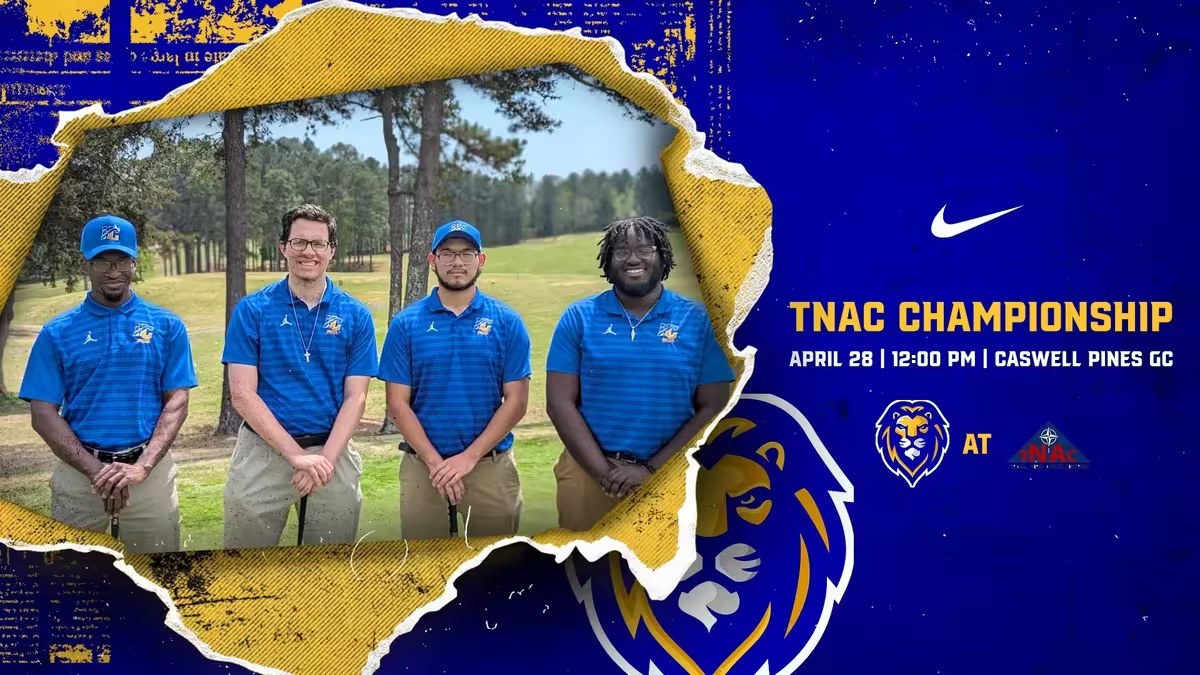
When Henderson Collegiate launched their lion mascot with deliberate student input, the results validated everything we know about spirit wear psychology. Within just a few months, most students were regularly wearing mascot gear - an adoption rate that most schools dream of achieving. The following year, enrollment inquiries grew as word-of-mouth marketing spread through student networks. Social media sharing increased dramatically as students posted mascot content organically. Even student retention improved because pride drives engagement.
Read the full Henderson Collegiate case study to see how strategic mascot design drove measurable enrollment growth.
The success wasn’t accidental. It was student-centered from the start, with students helping shape the mascot concept and feeling genuine ownership. The design was professionally executed at a quality level that made students proud rather than embarrassed to wear it. Student ambassadors created peer-to-peer marketing that spread through social networks organically. And critically, the lion mascot represented “Pride” - one of their core school values - creating an emotional connection that transcended just having a cool logo.
This demonstrates the principles covered in our guide on the role of a school mascot in building school culture and community.
The Marketing Impact
Let’s quantify what happens when students actively wear and share your mascot. Every student wearing your mascot is reaching roughly 100 people in their daily interactions - at sports practices, music lessons, grocery stores, restaurants, parks. They’re sharing mascot content on social media, generating organic reach to hundreds of followers. They’re talking to friends about their school experiences, creating word-of-mouth marketing that’s more trusted than any advertisement. And they’re signaling quality to prospective families who interpret widespread student adoption as social proof that your school is worth considering.
The math is compelling. If 500 students each have 100 daily interactions while wearing your mascot, that’s 50,000 brand impressions per day in your community. If those same 500 students each have 500 social media followers, that’s 250,000 potential impressions every time they post mascot content. And it’s all free marketing driven by student pride rather than advertising spend.
This isn’t hypothetical reach - it’s actual community visibility that prospective families notice and remember when making enrollment decisions.
The Enrollment Connection
When prospective families see students wearing your mascot throughout the community, they’re reading multiple signals simultaneously. Student pride signals that your school has positive culture where kids actually want to belong. Brand recognition signals professionalism and institutional credibility. Community engagement signals that your school is active and visible in local life. And quality signals excellence - schools where students are embarrassed by their mascot don’t generate widespread adoption.
This creates powerful social proof that influences enrollment decisions. Learn more about how school branding influences parent choice and the psychology behind enrollment decisions.
Parents making enrollment decisions are constantly looking for validation that they’re making the right choice. Seeing students enthusiastically wearing mascot gear provides that validation in a way that marketing materials simply can’t replicate.
5 Spirit Wear Marketing Principles
Based on our analysis of 250+ school branding projects, we’ve identified five principles that consistently drive spirit wear adoption and enrollment impact.
First, build genuine student ownership. This means getting direct student input on mascot design decisions, creating formal student ambassador programs to promote adoption, and giving students real influence over what represents their identity. In our experience, ownership is the single most powerful lever you can pull.
Second, ensure unquestionably professional design. Your mascot must look professional enough that students are proud rather than embarrassed to wear it. Spirit wear options need to be high quality, not cheap promotional items. Professional design drives sales because students will actually choose to wear well-designed gear even when they’re not required to. See our mascot design psychology guide for specific design principles.
Third, create deliberate social proof. Feature students wearing mascot gear across your social media channels. Share student testimonials and stories that showcase authentic pride. Make mascot adoption visible and socially rewarded. Social proof drives adoption because students follow what they see their peers doing. Learn more about school social media strategy for execution tactics.
Fourth, offer variety in spirit wear options. Different students have different style preferences - some want hoodies, others prefer t-shirts, caps, or accessories. Different families have different budgets, so price points should be accessible across economic ranges. Variety drives sales because it removes barriers to participation.
Fifth, make purchasing ridiculously easy. Set up online ordering systems so families don’t need to coordinate cash or checks through students. Create clear purchasing processes with simple navigation and straightforward options. Easy purchasing drives sales simply by removing friction from the transaction.
Action Item: Evaluate Your Spirit Wear Impact
Take an honest look at your current spirit wear program. Are students actively wearing your mascot around campus and in the community? Are they sharing mascot content on social media? Are families naturally purchasing spirit wear without aggressive promotion? If the answers are no or uncertain, you likely have an ownership problem - and you’re missing significant free marketing opportunities.
Start with these concrete next steps:
First, survey your students directly about mascot perception. Ask what they like, what they’d change, whether they feel proud or embarrassed wearing it, and whether they had any input in its creation. Their honest feedback will reveal whether you have an ownership problem, a design problem, or both.
Second, assess your actual spirit wear adoption rates. Walk through campus and count how many students are wearing mascot gear on a typical day. Check social media to see if students are voluntarily sharing mascot content. Compare your adoption rates to enrollment inquiry trends - they should correlate positively.
Third, build systematic student ownership through structured input processes and ambassador programs. Don’t just ask for feedback once - create ongoing mechanisms where students have genuine influence over mascot evolution and spirit wear options.
Fourth, evaluate whether your current mascot can support a strong spirit wear program or whether a strategic redesign would generate better enrollment results.
Transform Your Spirit Wear Into Enrollment Marketing
Spirit wear that students enthusiastically adopt becomes one of your most cost-effective marketing channels - but only when it’s built on genuine student ownership, professional design, and strategic social proof.
Ready to transform your spirit wear program? Our mascot logo design services help schools create mascots that students love and communities rally behind. See our portfolio for real examples and measurable enrollment results from schools that turned spirit wear into enrollment marketing.
The schools filling their enrollment pipelines aren’t outspending competitors on advertising - they’re empowering students to become brand ambassadors who drive word-of-mouth marketing organically. That’s the strategic advantage of spirit wear done right.
Related: alumni as brand ambassadors - how graduates carry your brand beyond campus and into the community as lifelong enrollment advocates. • mascot costume game day strategy - the complete deployment playbook for using your mascot costume at games, events, and community appearances.
We Build and Manufacture Mascot Costumes
A professionally built mascot costume creates unforgettable moments at games, rallies, and community events.

See Full Details →
Design to Delivery
We manage everything
6-12 Week Delivery
In time for your season
Safety First
Ventilation & visibility
Custom Projects
Professional quality
Custom School Mascot Costume
Bring your mascot to life for game day
Custom school mascot costumes designed for visibility, comfort, and durability. We design, prototype, and manage production so your performer can move, engage, and win crowds.
Get Costume Pricing →Related
Custom School Mascot Costume
Custom school mascot costumes designed for visibility, comfort, and durability. We design, prototype, and manage production so your performer can move, engage, and win crowds.
View detailsRelated
Charter Application Branding - Professional Identity for Authorizer Approval
Professional charter application branding that demonstrates operational readiness to authorizers. Complete brand identity, website, and application materials. Charter-specific packages for charter schools.
View details