School Branding Blog
Middle School Branding: The Complete Guide to 6-8 Identity
- Author
- Mash Bonigala · Creative Director
- Published
- January 27, 2026
- Read
- 15 min

Middle schools have an identity problem. Not the students. The schools themselves.
Elementary schools get the cute mascots, the colorful logos, the warm fuzzy branding that makes parents feel good about dropping off their 5-year-old. High schools get the fierce athletics branding, the legacy imagery, the “we’re preparing you for the real world” messaging.
Middle schools? They get whatever’s left over. A watered-down version of the high school mascot. Colors that don’t quite match either feeder elementary or destination high school. Messaging that sounds like it was written by a committee who couldn’t decide if students were still kids or almost-adults.
This matters more than most administrators realize. Students aged 11-14 are in the most intensive identity-formation period of their lives. They’re figuring out who they are, who they want to be, what groups they belong to. And they’re doing this while navigating one of the biggest transitions in education - leaving the comfort of elementary school for a much larger, more complex middle school environment.
Your brand either helps them through this transition or makes it harder. There’s no neutral ground.
After working with dozens of middle schools on brand development, I can tell you what works, what doesn’t, and why most middle school branding falls flat.
Related: school branding strategy | middle school branding services | visual identity design
Why middle school branding is different
Middle school branding requires a completely different approach than elementary or high school.
The Developmental Stage Factor
Students aged 11-14 are in a unique psychological space. Peer influence is at its absolute peak. They’re acutely aware of what’s “cool” and what isn’t. They’re developing their own aesthetic preferences independent of their parents. They’re starting to reject things that feel “for kids” while not yet ready for fully adult content.
This creates a narrow window for brand design. Go too cute and students will actively resist wearing your spirit wear. Go too aggressive and parents will raise concerns about appropriateness. The sweet spot is a brand that feels mature enough for a 13-year-old to wear without embarrassment but appropriate enough that a 6th grader’s parents feel comfortable.
Most middle school brands miss this window entirely. They either inherit the elementary school’s cute mascot (which 8th graders reject) or adopt a toned-down version of the high school’s fierce mascot (which lacks its own identity).
The Transition Challenge
Here’s a problem unique to middle schools: your students come from multiple places with multiple existing loyalties.
A typical middle school might draw from 4-5 different elementary feeders. Each of those schools has its own mascot, its own colors, its own culture. Students arrive at middle school with Eagles sweatshirts and Bobcats t-shirts and Mustangs backpacks. They have allegiances to their old schools. Their identity is still tied to where they came from.
Your middle school brand needs to create a new shared identity without asking students to completely abandon their old one. This is a much more complex ask than elementary schools face (where students arrive as blank slates) or high schools (where students have already been unified by middle school).
REAL CHALLENGE
A 450-student middle school in Texas drew from five elementary feeders with different mascots: Eagles, Wildcats, Bears, Mustangs, and Panthers. The middle school’s generic “Wolves” identity failed to unite students - each elementary group sat together in the cafeteria through 8th grade. After a strategic rebrand focused on shared values rather than inherited rivalries, mixed-group seating increased noticeably within one semester.
The “Temporary” Perception Problem
Parents often view middle school as a 3-year holding pattern. A place to get through before the “real” high school experience begins. This perception shows up in community engagement: PTA participation drops, booster club involvement decreases, spirit wear purchases decline.
This isn’t because parents don’t care. It’s because the brand hasn’t given them a reason to invest emotionally in these three years. If your middle school brand feels like a placeholder, parents will treat it like one.
The schools that overcome this problem do so with brands that communicate significance. The message isn’t “this is where you wait until high school.” It’s “this is where you become who you’re going to be.”
The Middle School Branding Framework
Based on our work with middle schools across the country, we’ve developed a framework specifically for 6-8 identity development.
Identity Pillars for 6-8 Schools
Elementary school brands typically rest on pillars of fun, safety, and nurturing. High school brands emphasize achievement, tradition, and preparation. Middle school needs its own pillars.
Pillar 1: Confidence & Growth The core message isn’t “you’re still a kid” (elementary) or “you’re almost an adult” (high school). It’s “you’re becoming something.” Middle school is transformation. Your brand should reflect potential and progress, not a fixed state.
Pillar 2: Achievement & Preparation This serves as the bridge to high school. Middle school isn’t just passing time - it’s building the skills, habits, and knowledge that high school will build upon. Your brand should communicate that these years matter, that work done here has real impact on what comes next.
Pillar 3: Community & Belonging For 11-14 year olds, belonging is everything. They’re figuring out their social identity. A strong brand gives them something to belong to - a shared identity that transcends the elementary school cliques they arrived with.
THE MIDDLE SCHOOL SWEET SPOT
Too Young
Cute mascots, bright colors, playful fonts. Students reject it as “babyish.” Parents love it but students won’t wear it.
Just Right
Confident mascots, sophisticated palettes, modern typography. Students claim it. Parents approve. Works for all three grades.
Too Old
Aggressive imagery, edgy design, high school intensity. Parents push back. 6th graders feel excluded.
Visual Identity Considerations
The visual execution of a middle school brand requires careful calibration.
Color Palettes Move away from the primary colors common in elementary school branding. Middle school palettes should feel more sophisticated: deeper shades, more complex color relationships, less “crayon box” and more “design studio.” This doesn’t mean dark or muted - it means intentional and refined.
Mascot Expression If your mascot has a face, its expression matters enormously. Elementary mascots often smile warmly. High school mascots often snarl aggressively. Middle school mascots should look confident and determined. Think less “friendly greeter” and more “athlete about to compete.” Not angry, but focused. Not cute, but capable.
Typography This is where many middle school brands fail. They either inherit the playful fonts of elementary school (which feel childish) or adopt the traditional serifs of high school (which feel stuffy). Middle school typography should be modern, bold, and clean. Sans-serif fonts generally work better. The weight should communicate confidence without aggression.
Messaging That Resonates
Your brand messaging needs to work for two very different audiences: students and parents. These require different approaches.
Student-Facing Messaging Avoid anything that sounds like it’s talking down to students. “You’re becoming something special” works. “You’re such great kids” doesn’t. Middle schoolers can detect condescension instantly. Speak to them as emerging adults, not as children. Focus on what they’re building, not what they currently are.
Parent-Facing Messaging Parents want to know their child is safe, supported, and prepared for high school. Your messaging should emphasize the seriousness of the academic program, the quality of the community, and the bridge this provides to future success. Avoid anything that makes middle school sound like a holding pattern.
Avoiding Common Tropes Don’t call students “our little scholars” or “almost high schoolers.” Don’t use messaging that sounds like a greeting card. Don’t try too hard to be cool or use slang that will be outdated in 6 months. Just communicate clearly what your school does and why it matters.
Mascot Design for Middle Schools
The mascot question is where many middle school branding projects start. Often the existing mascot is either inherited from the district, borrowed from the high school, or stuck in a design from decades ago.
Evolution from Elementary Mascot
If your middle school shares a mascot with feeder elementary schools (common in unified districts), you need to evolve it. The same mascot should feel different - more mature, more capable, more ready for competition.
This evolution typically involves:
- More dynamic poses (action vs. standing)
- Stronger expressions (confident vs. friendly)
- Refined details (cleaner lines vs. cartoon-style)
- Updated color application (more sophisticated palette use)
The goal is continuity with growth. A student should look at the elementary mascot and the middle school mascot and see the same character at different life stages.
MASCOT EVOLUTION EXAMPLE
Elementary: Friendly eagle with soft lines, waving wing, gentle smile
Middle School: Same eagle, now in flight, wings spread, focused expression, sharper details
High School: Same eagle, diving aggressively, fierce expression, maximum detail
Result: Students feel progression, not replacement. District brand stays unified.
Common Middle School Mascot Mistakes
Mistake 1: Too Childish Keeping the round shapes, big eyes, and friendly waves of an elementary mascot. 8th graders will refuse to wear it. Spirit wear sales crater. Student engagement drops.
Mistake 2: Too Aggressive Jumping straight to the snarling, teeth-baring intensity of a high school athletic mascot. 6th graders (and their parents) feel it’s inappropriate. Parent concerns rise.
Mistake 3: Too Generic Using a stock mascot design that looks like every other school. No differentiation, no ownership, no pride. Students see it as forgettable and treat it accordingly.
Mistake 4: Too Complex Adding so much detail that the mascot can’t reproduce at small sizes. Looks great on a poster, disappears on a shirt pocket. Digital applications fail.
For a deeper dive into mascot design principles, see our complete guide to mascot design psychology and our mascot logo design service.
Feeder School Alignment Strategy
One of the biggest challenges in middle school branding is managing the transition from multiple elementary schools into one unified identity.
District-Wide Brand Architecture
The best solution is a district-wide brand architecture that plans for these transitions from the start. This means:
- Shared core elements (district color system, typography standards)
- Unique school identities within that system
- Visual progression from elementary to middle to high school
- Clear relationships between feeder and destination schools
When this architecture exists, students arrive at middle school understanding they’re entering the next level of a system they already know. The transition feels like progression, not replacement.
When it doesn’t exist, students arrive carrying conflicting loyalties to their elementary schools and facing a middle school brand that seems disconnected from everything they know.
Multi-Feeder Challenges
When students come from 4-5 different elementary schools, each with its own mascot and colors, you face a unification challenge. Here’s how to address it:
Create Shared Rituals Don’t rely on the brand alone to unify students. Create rituals that build shared experience: orientation events, grade-level traditions, competitions that mix students across old elementary lines.
Acknowledge Without Competing Let students display pride in their elementary school backgrounds - but make middle school identity something additional, not replacement. “You were a Wildcat, now you’re also a Wolf” works better than “forget about being a Wildcat.”
Focus on What’s New Rather than asking students to transfer loyalty from something they already love, give them something new to love. Middle school should offer experiences, opportunities, and identity markers that elementary school couldn’t provide.
For more on managing multi-school brand architectures, see our guide to district branding and unifying multiple schools.
Student Engagement Through Brand
A middle school brand only works if students actually engage with it. This requires understanding what students aged 11-14 will and won’t do.
Spirit Wear That Actually Gets Worn
Middle schoolers are brutally honest about what they’ll wear. Here’s what works:
Style Matters More Than Message Students will wear something that looks good before they’ll wear something with a clever message. Prioritize design quality over quantity of branding. A subtle, well-designed piece beats a loud, cluttered one.
Fit and Fabric Count Cheap, boxy t-shirts end up as pajamas or donations. Invest in pieces that actually fit well and feel good. The per-unit cost is higher but the wear rate is dramatically better.
Offer Options Not every student wants the same thing. Offer variety in style (hoodies, quarter-zips, t-shirts, polos) and subtlety (some with large logos, some with small). Let students express their identity within your brand.
Watch the Trends What high school and college students are wearing filters down to middle school. Stay aware of broader fashion trends and incorporate them into spirit wear design. This doesn’t mean chasing every TikTok trend, but it does mean not offering the same styles you offered in 2015.
For detailed guidance on spirit wear strategy, see our spirit wear marketing guide.
Digital Brand Presence
Middle school students live online. Your brand needs to work in digital spaces.
Social Media Considerations Most platforms have age restrictions that affect middle schoolers (13+ for most major platforms). Work within these constraints. Focus on platforms where your audience actually is, and recognize that much of your social presence may be consumed by parents rather than students.
Visual Standards for Digital Your logo needs to work as a profile picture. Your colors need to display accurately on screens. Your brand needs to be recognizable in a small square thumbnail. Many school brands fail these basic digital tests.
Student-Created Content With appropriate guidelines and oversight, student-created content can be powerful brand building. Middle schoolers are natural content creators. Give them guardrails and let them contribute to telling your school’s story.
Physical Environment Branding
The physical environment is branding you can’t escape. Students spend hours in your buildings every day. What does that environment communicate?
High-Impact Locations Focus budget on high-traffic, high-visibility areas: main entrance, cafeteria, gymnasium, main hallways. A single well-designed wall beats ten poorly designed ones.
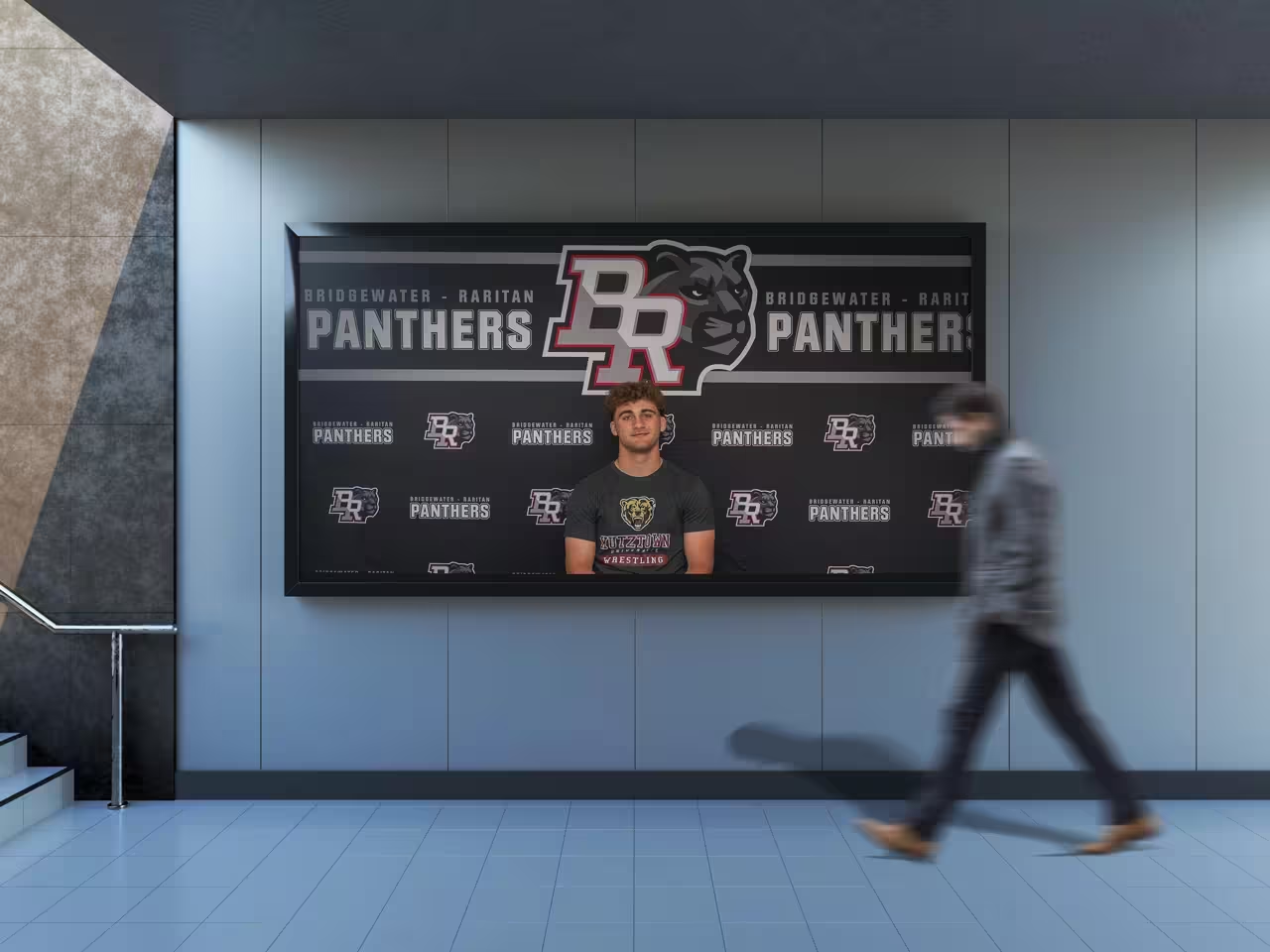
Create Photo Moments Students photograph everything. Give them branded backdrops worth photographing. A well-designed wall, a statement piece, a creative installation - these become organic marketing as students share them.
Avoid Clutter More isn’t better. A clean, focused brand application beats a cluttered mess of banners, signs, and decals. Edit ruthlessly. Let white space work.
Case Study: Middle School Brand Transformation
A 6-8 school in the Midwest faced declining enrollment and engagement. Here’s what happened.
The Challenge The school had lost students steadily over four years. Spirit wear sales had dropped sharply. Parent survey scores showed declining satisfaction. The existing brand was a generic mascot that shared nothing with district elementary or high school brands.
The Discovery Process We conducted stakeholder interviews with students, parents, staff, and community members. The findings were consistent: nobody felt ownership of the brand. Students described it as “boring.” Parents couldn’t articulate what made the school special. Staff admitted they rarely wore branded items.
The Strategic Approach Rather than jumping to logo design, we started with positioning. What did this school do that no other school did? What did students experience here that they wouldn’t experience elsewhere? We identified three core differentiators and built the brand strategy around them.
The Visual Solution The new mascot connected to the high school mascot (same animal, different execution) while feeling distinctly “middle school.” The color palette evolved from the elementary schools’ primary colors toward the high school’s deeper tones - a literal visual bridge. Typography and supporting graphics were designed to feel current without chasing trends.
The Implementation Rollout happened over a summer. New signage, new spirit wear, new digital presence. Staff received training on brand standards and storytelling. Students participated in a launch event that made them feel ownership of the new identity.
The Results
- Enrollment stabilized and grew the following year
- Spirit wear sales increased substantially
- Parent satisfaction scores improved
- Student engagement metrics (club participation, event attendance) increased across all measures
The investment was $45,000 for complete brand development and implementation materials. The enrollment gains that followed more than covered that investment.
Implementation Timeline for Middle Schools
When should you do this work, and how long does it take?
Summer Rebrand Strategy
The ideal window for middle school rebranding is summer. This allows you to launch the new identity with the new school year, maximizing the impact of “fresh start” psychology.
12 Weeks Before School Starts
- Discovery and research complete
- Strategy approved
- Design development underway
8 Weeks Before School Starts
- Core identity finalized (logo, colors, typography)
- Applications in development (signage, spirit wear, digital)
- Vendor orders placed for physical materials
4 Weeks Before School Starts
- Staff training on brand standards
- Physical installations in progress
- Digital presence updated
- Spirit wear available for pre-order
Launch Week
- New identity revealed to students and community
- Launch event creates excitement and ownership
- Brand ambassador program begins
Staff Buy-In for Middle School
Teachers and staff are your most important brand ambassadors. Getting their buy-in requires:
Early Involvement Include staff representatives in the discovery process. When staff feel heard, they’re more likely to champion the result.
Clear Rationale Explain why the rebrand is happening and what it’s meant to achieve. “Because we wanted something new” isn’t convincing. “Because research showed students weren’t engaging with our brand, and engagement directly affects enrollment” makes the case.
Practical Training Don’t just show staff the new logo - show them how to use it. Provide templates, guidelines, and examples. Make it easy to do things right.
Address Resistance Some staff will resist. “We’ve always done it this way” is a common refrain. Listen to concerns, acknowledge the emotional connection to old branding, but stay focused on the student benefit.
Student Involvement
Getting students involved in the branding process increases ownership. But middle schoolers need structured involvement, not open-ended input.
Appropriate Input Gathering Ask students about preferences and perceptions, not design decisions. “What makes you proud to be a student here?” is useful. “What should our logo look like?” is not.
Launch Event Ideas
- Spirit rallies with reveal moments
- Student-designed merchandise contests (within brand guidelines)
- Social media takeovers with brand launch content
- Inter-grade competitions using new brand elements
Common Middle School Branding Mistakes
Avoid these errors that we see repeatedly:
Mistake 1: Treating It Like Elementary Branding Middle school isn’t elementary school with taller students. The approach, aesthetic, and messaging all need to mature. Keep the warmth but lose the cute.
Mistake 2: Making It Too “Try-Hard” to Be Cool Attempting to use current slang, memes, or trends in permanent branding backfires fast. What’s cool in January is cringe by April. Focus on timeless quality over momentary relevance.
Mistake 3: Ignoring the Three-Year Timeline Perception If you don’t actively communicate that these three years matter, parents will treat them as a holding pattern. Build significance into your brand messaging.
Mistake 4: Not Connecting to High School Brand Middle school is a bridge. Your brand should visually and strategically connect to the high school destination. Students should see middle school as the path forward, not a detour.
Mistake 5: Forgetting Parents Entirely Yes, students need to embrace the brand. But parents make enrollment decisions, volunteer their time, and write checks for spirit wear. Your brand needs to work for them too.
For more on avoiding branding errors, see our guide to mascot design mistakes that cost enrollment.
Next Steps: Your Middle School Brand
If you’ve read this far, you’re likely considering a middle school branding initiative. Here’s how to move forward:
Step 1: Honest Assessment Is your current brand actually working? Survey students, parents, and staff. Look at spirit wear sales and event participation. Check enrollment trends. Don’t assume - measure.
Step 2: Determine Scope Do you need a refresh or a complete rebrand? A refresh modernizes existing elements. A rebrand rethinks everything. The answer depends on how much equity your current brand holds. See our brand refresh vs. rebrand decision framework.
Step 3: Get the right help. This isn’t a project for the art teacher’s nephew or a crowdsourced logo contest. Strategic school branding requires experience with the specific challenges schools face, and middle school has its own dynamics.
Middle school is where students start figuring out who they might become. Your brand should reflect that possibility. Get it right, and you give students something to belong to during a time when belonging matters more than anything.
Where to start
- Run a brand audit
- Explore middle school branding services
- See what we’ve done for 250+ schools
- Talk to us
More on this topic: School Branding and Student Belonging | Mascot Design Psychology | Spirit Wear as Marketing | Brand Refresh vs. Rebrand
We Build and Manufacture Mascot Costumes
A professionally built mascot costume creates unforgettable moments at games, rallies, and community events.

See Full Details →
Design to Delivery
We manage everything
6-12 Week Delivery
In time for your season
Safety First
Ventilation & visibility
Custom Projects
Professional quality
School Marketing Design | Enrollment Campaigns & Materials
Turn your brand into enrollment campaigns
Transform your school's marketing with compelling campaigns, enrollment materials, and digital strategies that drive student recruitment and community engagement.
Get Marketing Help →Related
School Marketing Design | Enrollment Campaigns & Materials
Transform your school's marketing with compelling campaigns, enrollment materials, and digital strategies that drive student recruitment and community engagement.
View detailsRelated
Charter Application Branding - Professional Identity for Authorizer Approval
Professional charter application branding that demonstrates operational readiness to authorizers. Complete brand identity, website, and application materials. Charter-specific packages for charter schools.
View details