School Branding Blog
School Mascot Performer Training Program: How to Recruit, Train, and Manage the People Inside the Costume
- Author
- Mash Bonigala · Creative Director
- Published
- April 16, 2026
- Read
- 12 min
School Mascot Performer Training Program: How to Recruit, Train, and Manage the People Inside the Costume
Your mascot costume is a $5,000 brand asset. The person inside it is a volunteer with zero training.
That gap - between the investment in the costume and the investment in the performer - is where most school mascot programs fall apart. The costume looks incredible. The performance does not. The character wanders aimlessly at games. It frightens a kindergartner by moving too fast. It overheats in the third quarter and disappears. It acts goofy one week and aggressive the next because two different students play it two different ways.
None of these are costume problems. They are all performer problems. And they are all solved by the one thing most schools never build: a structured mascot performer program.
From our work across 250+ K-12 branding and mascot projects, schools with trained performer teams deliver far more appearances per year, generate significantly more social media content, and report higher student engagement at events than schools that treat the costume as a grab-and-go prop. The difference is not budget. It is preparation.
This guide covers how to recruit the right performers, train them to deliver consistent and safe appearances, and manage a team that keeps your mascot active all year.
Related: mascot costume game day strategy • mascot costume complete guide • mascot reveal event playbook • costume construction process • mascot costume service
Section 1: Why Performer Training Changes Everything
A mascot costume without a trained performer is like a grand piano without a pianist. The instrument is beautiful. The sound is terrible.
Most schools skip performer training entirely because it feels unnecessary. The costume does the work, right? Put someone in the suit, point them at the crowd, and the mascot magic happens automatically.
It does not. Here is what actually happens without training:
Inconsistent character. Monday’s performer plays the mascot as a clown - exaggerated stumbling, silly dances, slapstick humor. Friday’s performer plays it as a tough guy - chest bumps, aggressive posturing, intimidating stances. The audience experiences two completely different characters wearing the same costume. Your mascot has no identity. It has multiple personalities.
Safety incidents. An untrained performer cannot see well inside the head, misjudges distances, and trips over a toddler. Or they overheat because no one told them to take breaks, and they collapse on the sideline during the fourth quarter. Or they roughhouse with a high schooler and the costume head takes an elbow, cracking the shell. Every one of these incidents has happened at schools we have worked with - and every one was preventable.
Low appearance frequency. Without a rotation system, one student carries the entire burden. They perform at three games, realize how exhausting it is, and stop volunteering. The costume goes back in the closet. Schools with a single untrained performer manage only a handful of appearances per year. Schools with a trained team of 3-5 performers can cover far more.
Missed brand value. An untrained performer does not understand that they are not just entertaining a crowd - they are representing a brand. Every interaction is a brand touchpoint. Every photo is marketing content. Every community appearance is an enrollment signal. Without this context, the performer treats the role as a joke rather than a responsibility. For the full picture on how mascot appearances drive enrollment, see our game day deployment strategy.
Training transforms all of this. It gives every performer the same character playbook, the same safety protocols, and the same understanding of why the role matters. The result is a mascot that feels like one consistent, professional, beloved character - regardless of who is inside.
Section 2: Recruiting the Right Performers
Not every student is cut out for mascot performance. The role demands a specific combination of physical stamina, personality, and reliability that you need to recruit for intentionally - not just accept whoever raises their hand.
The Ideal Performer Profile
Physical requirements. The performer must be able to move energetically in a costume that weighs 15-30 pounds, restricts peripheral vision, and traps body heat. They need baseline cardiovascular fitness - not athlete-level, but enough to dance, wave, and move continuously for 30-45 minutes. They should be comfortable with limited visibility and have no claustrophobia issues.
Performance instincts. The best mascot performers communicate entirely through body language. No voice. No facial expressions. Just exaggerated gestures, posture, and movement. Students who are naturally expressive - big reactions, animated conversations, comfort being the center of attention - adapt to this constraint quickly. Quiet, reserved students often struggle regardless of how much they want the role.
Reliability. This matters more than talent. A mediocre performer who shows up to every scheduled appearance is worth more than a brilliant performer who cancels half the time. Mascot programs live and die on consistency. Recruit students with a track record of showing up.
Character fit. The performer’s body type should reasonably fit the costume. Most mascot costumes are built for performers between 5’4” and 6’0” and 130-200 pounds. Performers significantly outside this range may struggle with visibility, mobility, or costume fit - and altering the costume to accommodate extreme size differences can compromise its appearance.
Where to Recruit
Drama and theater students. They already understand character work, physicality, and performing without breaking character. The mascot role is essentially a physical acting role with no lines - theater students excel at this.
Cheerleaders and dance team members. They have the stamina, the crowd engagement instincts, and the schedule alignment since they are already at most athletic events. Some cheer programs formally incorporate mascot performance into their roster.
Student government and spirit leaders. These students are already invested in school culture and have the organizational reliability you need. They understand that the mascot represents the school, not themselves.
Athletes in their off-season. A basketball player who wants to stay involved during football season, or a spring sport athlete available in the fall, brings the fitness level and competitive energy that translates well to mascot performance.
The Recruitment Process
Do not just post a sign-up sheet. Run a structured recruitment that signals the role’s importance.
Step 1: Information session. Host a 30-minute session where you explain what the mascot program involves, show the costume, demonstrate the time commitment, and answer questions. This filters out students who think it sounds fun but are not prepared for the reality.
Step 2: Tryout. Yes, a tryout. Not an audition - a tryout. Ask candidates to:
- Perform a 60-second dance or movement routine without music (tests expressiveness)
- React to three scenarios in character without speaking: a crying child, an excited student section, a boring halftime (tests improvisation)
- Wear the costume head and walk a short obstacle course (tests comfort with limited visibility)
- Answer questions about their schedule availability and commitment level
Step 3: Selection. Choose 3-5 performers. Notify them formally - a letter, a meeting with the athletic director or principal, something that communicates the role carries weight. This sets the tone for treating the program seriously from day one.
Section 3: The Training Program
Training is where you transform a group of enthusiastic students into a unified mascot team that delivers the same character at every appearance. The goal is simple: no matter who is inside the costume, the audience experiences the same mascot.
Phase 1: Character Development (Sessions 1-2)
Before anyone puts on the costume, the team needs to agree on who the character is.
Define the character profile. Work with the team to document:
| Character Element | Description | Example (Eagle mascot) |
|---|---|---|
| Personality | Core traits that define behavior | Confident, playful, protective |
| Energy level | Default intensity | High energy but controlled - never frantic |
| Movement style | How the character walks and stands | Proud posture, chest forward, deliberate strides |
| Signature gestures | 3-5 repeatable moves | Wing spread celebration, beak-point at crowd, talon stomp |
| Interaction style | How the character engages people | Initiates contact, kneels for small children, mirrors student energy |
| Boundaries | What the character never does | Never speaks, never removes the head in public, never makes aggressive contact |
Write a one-page character bible. This document becomes the reference every performer uses. It should fit on a single page and be posted inside the costume storage area. When a new performer joins mid-year, the character bible is their first training material.
Watch film together. Study professional mascot performances - NBA, NFL, and college mascots on YouTube. Identify what works: how professionals use head tilts to show emotion, how they engage different sections of a crowd, how they recover from awkward moments. Also identify what does not work: mascots that are too aggressive, too passive, or break character.
Phase 2: Physical Training (Sessions 3-4)
Now the costume comes on.
Suiting up protocol. Every performer learns the exact sequence for putting on and removing the costume. This is not optional - improper suiting up damages costumes and wastes time. A standard sequence:
- Base layer (moisture-wicking athletic wear, never cotton)
- Body suit and padding
- Feet and shoes
- Gloves (attached or tucked)
- Head (secured, visibility confirmed)
- Handler confirms readiness
Removal is the reverse. Time each performer. The target is under 5 minutes for full suit-up, under 3 minutes for removal. Emergency removal - handler-assisted head removal - should take under 30 seconds.
Visibility navigation. The costume head restricts peripheral vision to roughly 30-40% of normal. Performers must learn to:
- Turn their entire body to look left or right, not just their head
- Use slow, sweeping head movements to scan their surroundings
- Navigate stairs by gripping the railing and stepping deliberately (or avoiding stairs entirely - preferred)
- Identify obstacles on the ground by tilting the head forward periodically
- Trust their handler’s voice guidance in crowded or unfamiliar environments
Movement vocabulary. Practice the character’s signature movements until they are second nature:
- The character walk (not the performer’s natural walk)
- The celebration move (used after scores, big moments)
- The greeting gesture (used when approaching individuals)
- The photo pose (a consistent, recognizable stance for photos)
- The recovery move (what the character does after tripping, bumping into something, or having an awkward moment - staying in character during mistakes is what separates trained performers from amateurs)
Stamina conditioning. Have performers wear the full costume for progressively longer sessions:
- Session 3: 15 minutes in costume, then break and debrief
- Session 4: 30 minutes in costume with active movement, then break
Monitor for signs of overheating: sluggish movement, loss of character energy, stumbling. Teach performers to recognize their own limits and use the tap-out signal before they hit a wall.
Phase 3: Crowd Engagement Training (Sessions 5-6)
This is where performers learn to work an audience - the skill that separates a person in a suit from a beloved school mascot.
Age-appropriate interaction. Different audiences require different approaches:
| Audience | Approach | Avoid |
|---|---|---|
| Pre-K to 2nd grade | Slow approach, kneel to their level, gentle waves, let them come to you | Sudden movements, looming over them, grabbing or picking up |
| 3rd to 5th grade | High-fives, fist bumps, silly dances, exaggerated reactions | Ignoring them, being too still, complex routines they cannot follow |
| Middle school | Mirror their energy, challenge them to dance-offs, acknowledge groups | Being “uncool,” trying too hard, singling out reluctant students |
| High school | High energy, student section focus, coordinated chants, competitive bits | Being passive, standing on the sidelines, breaking character for laughs |
| Parents and families | Photo-ready poses, gentle humor, include everyone in the frame | Ignoring adults, focusing only on children, blocking sightlines |
The 10-second rule. Every interaction should last roughly 10 seconds. Approach, engage, connect, move on. Performers who linger too long with one person or group miss dozens of other interactions. The mascot should feel like it is everywhere - not stuck in one spot.
Photo protocol. The mascot will be photographed constantly. Train performers on:
- A default photo pose that looks good from any angle
- How to position themselves so the school logo on the costume faces the camera
- Pausing long enough for the photo (a full 3-count, not a drive-by)
- Looking at the camera lens, not the person - even though the audience cannot see the performer’s eyes, the head angle matters
Energy management. A performer cannot sustain maximum energy for 45 minutes. Teach the rhythm:
- High energy for the first 5 minutes of each rotation (arrival generates excitement)
- Moderate energy for the middle portion (sustained engagement, working the crowd methodically)
- High energy for the final 5 minutes (leave on a peak, not a fade)
- Recovery during the hand-off to the next performer (hydration, cooling, debrief)
Handling difficult situations. Train responses for scenarios that will inevitably happen:
- A child starts crying: step back slowly, wave gently from a distance, let a parent comfort the child. Never chase a scared child.
- A student tries to pull off the head: firmly but gently redirect their hands, move away, signal the handler. Never break character to scold.
- Someone is aggressive or mocking: play along with humor if safe, disengage if not, signal the handler if it escalates. Never retaliate physically or break character in anger.
- The costume malfunctions (glove falls off, shoe comes loose): the handler assists immediately. The performer moves to a low-visibility area. Fix, recover, return.
Section 4: Safety Protocols and Handler Systems
Mascot performance is physically demanding and carries real risk. Heat exhaustion, falls, crowd-related injuries, and costume malfunctions all happen - and they happen more often at schools without written safety protocols. This section is not optional. It is the foundation that protects your performers, your students, and your school from liability.
The Handler Role
Every mascot appearance requires a handler. No exceptions. The handler is a dedicated person - student or adult - who stays within 10 feet of the performer at all times and serves as their eyes, ears, voice, and safety net.
Handler responsibilities:
- Navigation. Guide the performer through crowds, doorways, and uneven terrain. The performer’s vision is limited to roughly 30-40% of normal. The handler fills the gap.
- Time management. Track how long the performer has been in costume and enforce break schedules. Performers lose track of time and push past their limits. The handler does not let that happen.
- Communication. Speak on behalf of the mascot when needed. Direct families for photos, explain that the mascot does not talk, manage crowd flow around the performer.
- Emergency response. If the performer signals distress, the handler initiates immediate removal to a private area. The handler carries water, a towel, and knows the location of the nearest air-conditioned space.
- Costume monitoring. Watch for wardrobe malfunctions - a drooping tail, a loose glove, a head tilting off-center - and fix them quickly before they become visible to the audience or create a safety issue.
Who should be a handler? Responsible students (junior or senior), parent volunteers, or staff members. Handlers should attend at least two training sessions with the performers so they understand the costume’s limitations and the performer’s communication signals.
Heat Management
Heat is the number one safety risk in mascot performance. A foam and fabric costume traps body heat aggressively. Internal temperatures inside a mascot suit can exceed ambient temperature by 20-30 degrees. On a 85°F day, the performer may be experiencing 110°F+ conditions inside the costume.
Mandatory protocols:
| Condition | Protocol |
|---|---|
| Below 75°F | Standard rotation: 45-minute maximum sets with 15-minute breaks |
| 75°F to 85°F | Shortened rotation: 30-minute sets with 15-minute breaks. Hydration at every break. |
| 85°F to 95°F | Limited deployment: 20-minute sets with 20-minute breaks. Indoor or shaded appearances only. Handler carries ice towels. |
| Above 95°F | No outdoor mascot appearances. Indoor climate-controlled appearances only, with 20-minute maximum sets. |
| Heat index above 105°F | No mascot appearances. Full stop. |
Pre-performance hydration. Performers should drink 16-20 ounces of water in the 30 minutes before suiting up. Not during - before. Once the costume is on, drinking requires head removal in a private area, which limits opportunities.
Cooling gear. Invest in a cooling vest ($30-$60) that the performer wears under the costume. These vests use ice packs or evaporative technology to reduce core body temperature. For schools in hot climates, this is not a luxury - it is essential equipment. Some schools also install small battery-powered fans inside the costume head, which can be specified during the costume construction process.
Warning signs every handler must know:
- Performer movements become sluggish or uncoordinated
- Performer stops engaging with the crowd and stands still
- Performer stumbles or leans against walls or objects
- Performer uses the distress signal (see below)
If any of these occur, the handler removes the performer from public view immediately. Head comes off first. Water and shade follow. If the performer shows signs of heat stroke - confusion, rapid pulse, hot dry skin, loss of consciousness - call 911.
Communication Signals
The performer cannot speak inside the costume. Establish a simple, unambiguous signal system between performer and handler:
Thumbs up (through the costume glove): “I’m good, keep going.”
Pat the stomach twice: “I need water at the next opportunity - not urgent.”
Tap the handler’s arm three times: “I need a break now. Get me to a private area.”
Cross arms over chest: “Emergency. Remove the head immediately.”
These signals must be practiced until they are automatic. In a loud stadium with thousands of people, the handler needs to recognize the signal instantly without second-guessing.
Liability and Documentation
Performer waiver. Every performer (and their parent or guardian if under 18) should sign a participation waiver that acknowledges the physical demands and risks of mascot performance. Your school’s legal counsel or risk management office can provide standard waiver language.
Incident documentation. If any safety incident occurs - a fall, a heat-related issue, a crowd interaction that results in contact - document it immediately. Date, time, what happened, who was involved, what action was taken. This protects the school, the performer, and the program.
Insurance check. Confirm with your school’s insurance provider that mascot performance is covered under existing student activity or athletic event policies. Most schools are already covered, but confirming in writing prevents surprises if an incident occurs.
Section 5: Managing the Performer Team
Recruiting and training performers is the hard part. Keeping them engaged, accountable, and available for an entire school year is the part that determines whether your mascot program survives past October.
Roster Structure
Build a team of 4-5 performers. This is not a suggestion - it is the minimum for a sustainable program.
| Roster Size | Reality |
|---|---|
| 1 performer | Burns out by mid-season. One illness or conflict cancels the appearance. Program dies by winter. |
| 2 performers | Slightly better, but no redundancy. If one quits, you are back to one. Both performers carry heavy burden. |
| 3 performers | Functional minimum. Two-person rotation at events with one backup. Tight but workable. |
| 4 performers | Comfortable rotation. Two active per event, two resting. Handles schedule conflicts and illness. Recommended starting point. |
| 5 performers | Ideal. Full flexibility for large events, built-in substitutes, reduced individual burden. Allows for one performer to graduate or leave without crisis. |
Assign a team captain. One performer serves as the lead - responsible for coordinating the schedule, communicating with the program advisor, and maintaining the costume between appearances. This student should be a junior or senior who can mentor newer performers and provide continuity when seniors graduate.
Scheduling and Accountability
Publish the rotation schedule monthly. Every performer should know their assignments at least two weeks in advance. Use a shared calendar - Google Calendar, a group chat, or whatever your student organizations already use. The point is visibility and accountability.
Standard game-day rotation:
- Performer A: Pre-game and first quarter (45 minutes)
- Performer B: Second quarter through halftime (45 minutes)
- Performer A or C: Third quarter through post-game (45 minutes)
- Handler rotates with the performer or stays the full event
Attendance expectations. Set clear expectations at the start of the year:
- Tier 1 events (homecoming, rivalry games, open houses) are mandatory for all available performers
- Tier 2 events (regular home games, assemblies) require at least two performers
- Tier 3 events (surprise appearances, content shoots) are voluntary but encouraged
- Each performer commits to a minimum number of appearances per month (typically 4-6)
Accountability system. Missing a scheduled appearance without advance notice should have a consequence - not punitive, but clear. A conversation with the program advisor. If it happens repeatedly, the performer loses their spot and an alternate moves in. The mascot program depends on reliability, and every team member needs to understand that from the start.
Character Consistency Across Performers
This is the hardest management challenge and the most important one. Five different people need to deliver one character.
Monthly character review. Once a month, the team watches video from recent appearances together. Not to criticize individuals, but to calibrate. Questions to discuss:
- Does the character’s energy feel consistent across performers?
- Are the signature gestures being used consistently?
- Is anyone developing habits that break character (nervous tics, passive posture, out-of-character movements)?
- Are there new situations the team should discuss and align on?
Buddy system for new performers. When a new performer joins mid-year, pair them with the team captain or a veteran performer for their first three appearances. The veteran performs one set, the new performer performs the next, and they debrief between sets. This mentorship transfers character knowledge faster than any written document.
The “golden rule” of mascot performance: The audience should never be able to tell which performer is inside the costume. If they can, your character consistency needs work.
Recognition and Retention
Mascot performers are volunteers doing physically demanding, anonymous work. If they do not feel valued, they quit.
Formal recognition. Treat mascot performers like any other school team:
- Include them in athletic banquet recognition or spirit squad awards
- Provide a letter or certificate at the end of the year that they can include in college applications - mascot performance demonstrates leadership, commitment, and community service
- Feature the team (without revealing who is in the costume) in the yearbook and school communications
Tangible perks. Small incentives that acknowledge the effort:
- Exclusive team gear (a jacket, hoodie, or t-shirt that identifies them as part of the mascot team - worn out of costume)
- Priority access to school events or reserved seating for events they are not performing at
- End-of-year celebration dinner or outing funded by the athletic booster club or PTA
The identity paradox. Mascot performers do their job anonymously. The whole point is that no one knows who is inside. This means they receive zero public recognition during performances - the crowd cheers for the character, not the person. Counterbalance this with behind-the-scenes recognition that makes the team feel seen. A principal who thanks a performer by name in a private setting, a coach who acknowledges the mascot team in a team meeting, a social media post celebrating “the team behind the mascot” at season’s end - these moments matter enormously.
Real-world proof
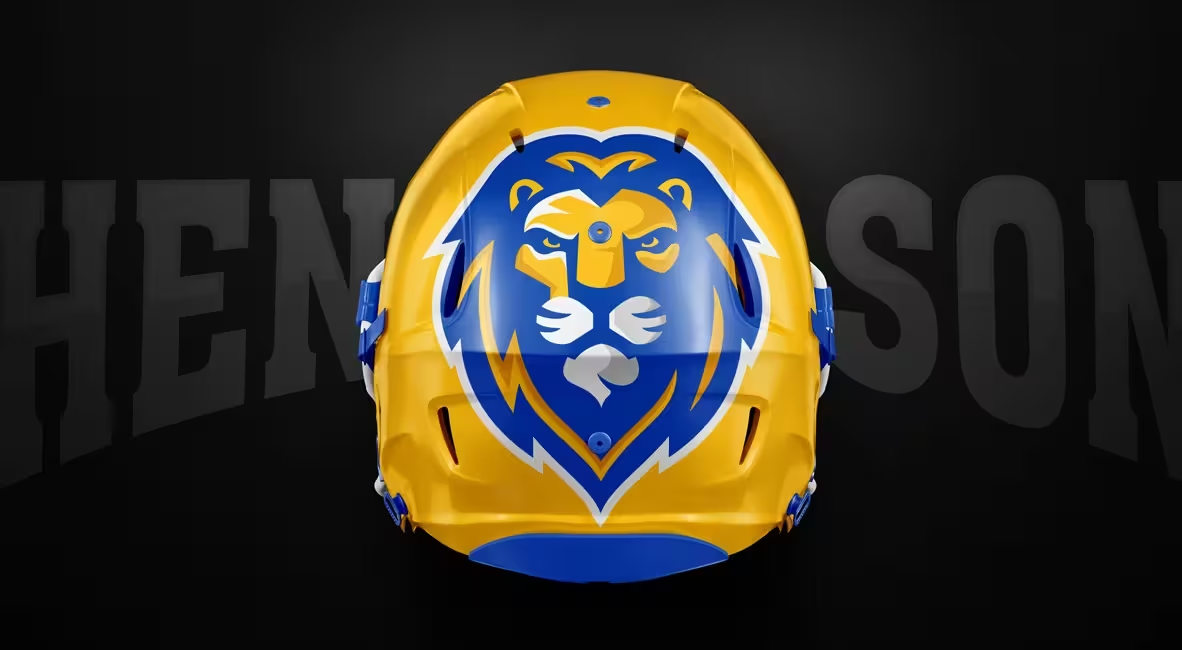
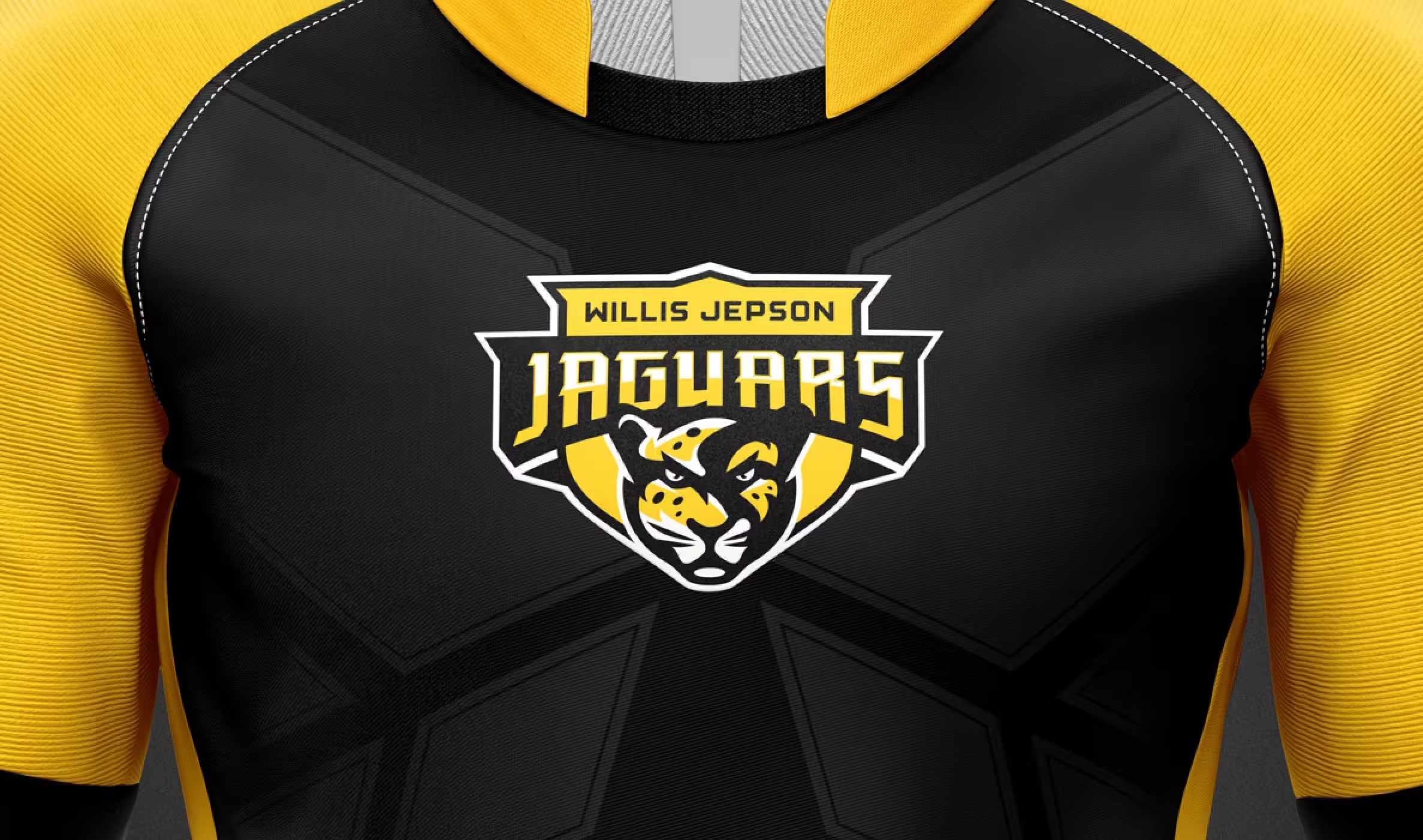
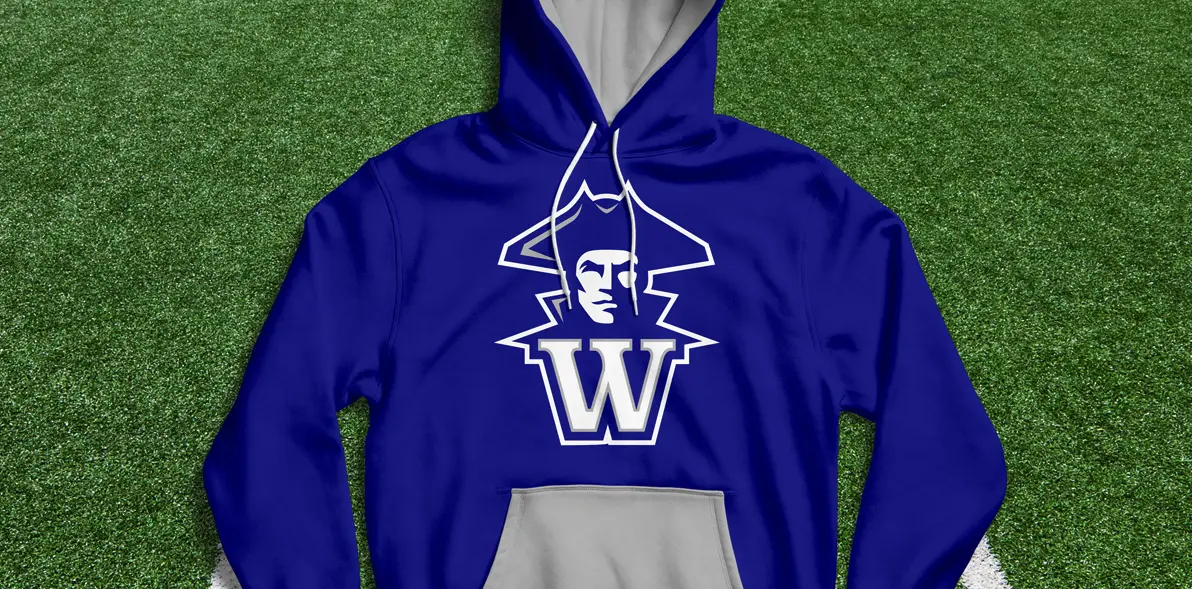
Schools with Mascot Programs That Build Lasting Culture
Section 6: Measuring Your Mascot Program’s Impact
A mascot program without metrics is a mascot program that loses funding. Track performance data that demonstrates value to administrators, athletic directors, and booster clubs - the people who decide whether the program continues.
Program Activity Metrics
| Metric | No Program | First Year | Mature Program |
|---|---|---|---|
| Total appearances per year | 8-12 | 25-35 | 45-60+ |
| Unique events covered | 5-8 | 15-20 | 30+ |
| Community appearances | 0-2 | 5-8 | 12-15 |
| Performers trained | 1 | 3-4 | 5+ with annual pipeline |
| Safety incidents | Untracked | Documented, declining | Near zero |
Engagement Metrics
Social media. Track the number of photos and videos captured at each appearance and the engagement they generate. Mascot content consistently outperforms other school content on platforms like Instagram and Facebook. If your social media team is not capturing content at every Tier 1 and Tier 2 appearance, you are leaving your highest-performing content on the table.
Event attendance. Compare attendance at events with and without mascot appearances. Schools in our network report higher attendance at games and events where the mascot is present - particularly for younger audiences and family-oriented events.
Spirit wear correlation. Monitor spirit wear sales during periods of high mascot visibility versus low visibility. Mascot appearances reinforce brand pride, and brand pride drives merchandise purchases. Schools with active mascot programs see measurably higher spirit wear adoption.
Enrollment Metrics
When prospective families attend open houses, campus visits, or community events, the mascot creates a memorable brand impression that influences enrollment decisions. Track:
- Enrollment inquiries that cite school spirit, culture, or community as a factor
- Open house attendance when mascot is present versus absent
- Feeder school visit-to-inquiry conversion rates
Schools that deploy their mascot strategically at enrollment events and community appearances report increases in inquiries tied to mascot visibility. For more on this connection, see our game day deployment strategy.
Annual Program Report
At the end of each school year, compile a one-page report that summarizes: total appearances, events covered, social media content generated, engagement metrics, performer roster status, and costume condition. Present this to the athletic director, principal, or booster club alongside next year’s calendar and budget request.
This report transforms the mascot program from “that fun thing we do sometimes” into a documented, data-supported school program that earns ongoing investment and attention.
Section 7: Building the Program - A 10-Week Launch Timeline
Whether you are starting from scratch or formalizing an existing ad hoc mascot effort, this timeline gets a structured program operational within one semester.
Weeks 1-2: Setup
- Assign a program advisor (staff member, coach, or student leadership sponsor)
- Inspect costume condition - repair or order a replacement if needed
- Set up a dedicated storage location with proper hanging and climate control
- Draft the semester appearance calendar across all three tiers
Weeks 3-4: Recruitment
- Host the information session
- Run tryouts
- Select 3-5 performers and notify them formally
- Recruit 2-3 handlers
Weeks 5-6: Character and Physical Training (Sessions 1-4)
- Develop the character profile and one-page character bible
- Watch and analyze professional mascot film
- Begin in-costume physical training with visibility navigation and movement vocabulary
- Establish the suiting-up protocol and emergency removal procedure
Weeks 7-8: Crowd Engagement and Safety Training (Sessions 5-8)
- Practice age-appropriate interaction scenarios
- Rehearse game-day rotation logistics with live timing
- Run a full safety protocol drill including handler communication signals and emergency removal
- Conduct 1-2 low-stakes test appearances (cafeteria lunch, morning greeting)
Weeks 9-10: Launch
- Deploy the full mascot team at the next major home event using the game-day playbook
- Capture photos and video for social media
- Debrief with the team after the first appearance: what worked, what to adjust
- Publish the next month’s rotation schedule
From this point forward, the program runs on its own rhythm - scheduled appearances, trained performers, consistent character, documented metrics. The initial investment of 10 weeks builds a system that sustains itself year after year, with new performers trained into an established culture rather than reinventing the program from scratch every fall.
The Person Inside the Costume Is the Brand
Schools spend months choosing their mascot and thousands building the costume. They spend zero time preparing the person who brings it to life.
That imbalance is why most mascot programs underperform. The costume is only as good as the performer inside it. And the performer is only as good as the training, safety systems, and team structure behind them.
Build the program. Recruit intentionally. Train systematically. Protect your performers with real safety protocols. Manage the team like any other school program - with schedules, accountability, and recognition.
When you do this, your mascot stops being a costume that someone occasionally wears and becomes what it was always meant to be: a living, breathing expression of your school’s identity that students remember, families connect with, and communities rally around.
Ready to build a mascot that performers love bringing to life? Our mascot logo design services create characters designed for costume performance from day one - not just screen display. See our mascot costume service for production, or explore our portfolio for real examples from 250+ schools.
Related: role of a school mascot • complete guide to school mascot design • why schools choose custom-manufactured costumes • alumni as brand ambassadors
We Build and Manufacture Mascot Costumes
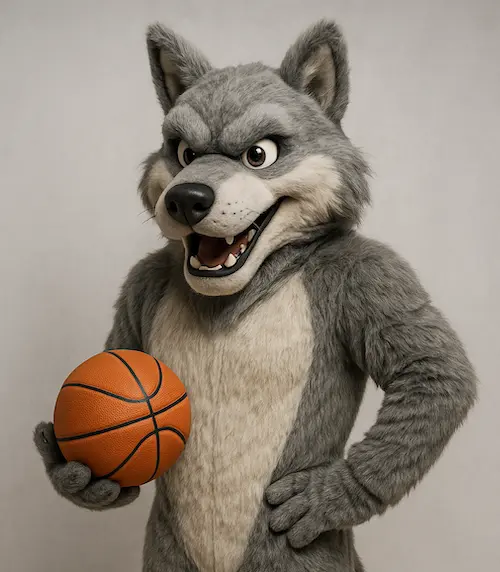
A professionally built mascot costume creates unforgettable moments at games, rallies, and community events.
See Full Details →
Design to Delivery
We manage everything
6-12 Week Delivery
In time for your season
Safety First
Ventilation & visibility
Custom Projects
Professional quality
Custom School Mascot Costume
Bring your mascot to life for game day
Custom school mascot costumes designed for visibility, comfort, and durability. We design, prototype, and manage production so your performer can move, engage, and win crowds.
Get Costume Pricing →Related
Custom School Mascot Costume
Custom school mascot costumes designed for visibility, comfort, and durability. We design, prototype, and manage production so your performer can move, engage, and win crowds.
View detailsRelated
Charter Application Branding - Professional Identity for Authorizer Approval
Professional charter application branding that demonstrates operational readiness to authorizers. Complete brand identity, website, and application materials. Charter-specific packages for charter schools.
View details